Showing posts with label Bookclub. Show all posts

Monday, January 9, 2012

The Stepford Wives by Ira Levin


The latest selection for Bookclub was Ira Levin's The Stepford Wives. The way our bookclub works is we talk about the book, until discussion is exhausted, then, if one is available, we watch a film adaptation of the book we've just finished talking about. This usually opens up further discussion in what has been kept or changed from book to film.

In the case of The Stepford Wives, there were two film versions made nearly 30 years apart, so we watched them both. I thought for this post, I'd talk about the book and then the movies.

I quite liked the book, it was plain, straightforward and built a nice sense of mystery. Levin seems to very much like to leave a lot out, to keep you guess, so that things are never confirmed. It can be refreshing, with all the writing these days that feels like they have to spell everything out, because heaven forbid there be any un-answered questions! With out giving the ending away, I'll warn those who don't like that sort of thing, that the book ends abruptly on a fairly dramatic cliffhanger and the coda of sorts explains nothing. This way, the reader can apply their own interpretation.

I do think that part of the 'horror'/'thriller' aspect of the book would have been magnified back in the 70's when the book was written. At the height of the second wave feminist movement, the very idea that men could be doing something to their wives to make them hotter and enthusiastically subservient would have been more abhorrent back when women were struggling so hard just to be seen as equals. That said, while the initial shock might not be what it was, the more I find myself thinking about it the more I find the idea appalling.

Anyway, it's a good read for a bit of vintage thriller.

On to the movies!

The original film was made in 1975 only a few years after the book was first published. All in all, it's a fairly good adaptation of the book, being pretty spot on as long as you don't count the whole climax where they've taken liberties to fill in some of the blanks left by Levin or just make it simply more dramatic. It's not too bad, but not entirely the most enthralling movie ever.


The second movie came out in 2004 and is a (much) less accurate translation from book to film, BUT, it is by far more enjoyable! This movie had me laughing all the way through it's so well done! I don't even like Nicole Kidman, but this movie is good despite her. Bette Midler plays a fantastic Bobbie and her book titles are great fun. This movie is just plain fun. and has a much more satisfying resolution for those that need that sort of thing. Glen Close does a great job too, the Model Stepford Wife!


Find it on Goodreads


Saturday, December 3, 2011

I Am Legend by Richard Matheson


This was a selection for bookclub that I found myself thinking, ok, I’d never have picked it up myself, but I’ll give it a go. Generally speaking, vampire books don’t excite me and I’d seen the most recent movie so I wasn’t over enthusiastic about reading the book.

However, I’ve now learned that whoever made the movie must have read the blurb on the back of the book, thought ‘Great premise, I’m going to make a movie now’ and gone and written something completely different and called it the same title as the book. Unfair to the book if you ask me. As far as adaptations go, the film is appalling. Sure, it’s watchable if you’re in the mood for putting up with Will Smith basking in his ‘Will Smith-ness’ for much of it, but the book is an entirely different experience.

Robert Neville lives alone, trying to survive the nightly attacks from a seemingly endless supply of vampires. Could he be the last living human on the planet? Routine stifles despair, but loneliness is unceasing.

For a book that in effect has one character, I Am Legend is mightily engaging. It knows when to use an action sequence to draw you in, or develop the emotional story to make you feel more. It knows when to skip forward or back in time so weeks, months, years, don’t feel at all tedious. And the ending (which I will not spoil for you) is fascinating and makes you think about all you’ve read and what you would feel in the same situation. Don’t believe the movie version; it’s ridiculous Hollywood slop compared to what (I think) Matheson was trying to say with his book.

If you like anything vaguely apocalyptical then you'll like this one. It’s an enjoyable read that might make you think too. Nice choice for bookclub, particularly if like us, you watch the film adaptations afterwards to discuss further. 

Saturday, October 1, 2011

The Left Hand Of Darkness by Ursula K. Le Guin


I’m a little unsure where to start with this review, so much so I almost wasn’t going to write it.

This is not a reflection on the book, but, if anything, a reflection on the audio book. I used a long trip for work to listen to the book, because it was my selection for Bookclub and I wasn’t sure where I was going to find the time to read it in amongst all my work and uni reading.

In retrospect, I would have been better to make the time to simply read it.

The story itself, as I suspected it would be (being a giant fan of Ursula Le Guin’s other writing) was fantastic. It was so fully realised and well constructed that, as usual, I was easily caught up in it.

The story, that is.

The audio book was the worst one I have ever listened to. It was clearly a digital recording taken from cassette tapes that sounded muffled and fuzzy, as if I were listing to a radio play on a wireless in some by-gone era. But on top of that, the quality and volume of the voice changed dramatically, and frequently, sometimes mid sentence. Further, the reader was not altering her voice at all for character, or emotion, or dramatic effect, so it took me a while longer than usual to differentiate who was saying what and which characters were which. She did, however, pause for breath in the most odd places, not where one would naturally pause if they were reading (aloud or in your head) which again threw me off.

Leaving that aside, I’ll now talk about the genius who was betrayed by this recording.

As with her other titles that I have read, Le Guin has made a perfectly tangible world for the reader to discover. This time set on a planet called Gethen where androgynous humans have a very different way of life to any that we know. Each person is gender neutral (or hermaphroditic) for most of the time, yet for 2 days out of every lunar cycle they enter ‘kemmer’ where they assume either male or female sexual organs in order to mate. To quote the book: “the mother of several children may be the father of several more.”

In this way, Le Guin has created a society where gender politics have been removed completely. It makes for a very interesting reflection of the nature of social gender constructs and how heavily they affect the way we think about people. Superbly done, the story is seen through the eyes of an outsider, a human from future earth. This way we are able to process what we are being shown in a way similar to our own constructed reality, yet with the scientifically and politically neutral commentary of the emissary.

One thought that I did have as I was listening to it, and after I had finished, was that it lacked the subtle, understated poetics that her writing for young adults has. This might have been because of the audio book, but others at bookclub found it hard to get into and somewhat uneventful. I’ll admit it was slow in places, and it took me a while to understand what was going on because of all the names and politics and relationships etc, took a while to be explained. But for those that love character development and don’t need too much action, then I’m sure there’s something in it for you too.

In the end, I’m glad I have read it. Judging by the quotes and reviews I’ve read, The Left Hand of Darkness is at the centre of the adult Sci-Fi and Fantasy canon. Personally, I prefer her Young Adult fiction, but I enjoyed this one all the same.


Friday, July 1, 2011

A Monster Calls by Patrick Ness & Siobhan Dowd


A Novel by Patrick Ness from an Original idea by Siobhan Dowd

The ‘Chaos Walking’ trilogy quickly and firmly established Patrick Ness as one of the authors that inspires me the most.

Therefore, I was more than excited to hear about his new work ‘A Monster Calls' and could not wait until I had read it. So much so, that when I had my hands on a copy, all other reading (regardless of how important – uni and work – were laid aside).

This particular book was born in the mind of Siobhan Dowd who, tragically, died before she could write it. In Patrick’s words: “She had the characters, a detailed premise, and a beginning. What she didn’t have, unfortunately, was time.”

So, in being invited to use Siobhan’s idea, Patrick let it grow, in the wild way of stories. Then he ran with it and made trouble.

And I for one am thrilled that he did. The story that these two have come up with is fantastic and one to be appreciated on any number of levels.

For me, it reads like a beautifully crafted modern fairy tale, full of modern sensibilities and psychologies. What I mean by this can easily be explained with a quote from the book:
There is not always a good guy. Nor is there always a bad one. Most people are somewhere inbetween.”

Mix that with the idea that not all stories have a happy ending and you get a brilliantly written tale of a boy’s struggle with his mother’s illness and a visit from a Monster as old as the earth who wants only one thing: the truth, spoken from Coner’s lips.

While the idea was Siobhan’s and the words Patrick’s, it would be unfair to review this book without reference to Jim Kay’s illustrations which perfectly capture the flickering, messy, darkness that would be conjured by one’s imagination were this tale read aloud by a dancing fireplace. Some illustrated novels seem like two works clumsily thrust together, the illustrations adding nothing, sometimes detracting from the written text. Jim Kay’s art adds to the snowball effect that began with the text, built in your imagination, was complemented by the artwork and had me glancing at the window to make sure that there was no such Monster peering in.

Moving, dark, and real, A Monster Calls can be devoured in one sitting and leaves you asking yourself: “What is my truth?”


Find it on Goodreads

Saturday, May 14, 2011

The Dice Man by Luke Rhinehart

As most reviews on my blog are for children’s or Young Adult books, I think I should start by saying that this one is for a book with ‘content’ and so some discussion of that ‘content’ might come through.

Then, to begin my review, I think I need to say I am reading this book 40 years after it was published, and therefore feel like it didn’t have the same effect on me that it seems to have had when it was released.

But, having said that, a book is a book no matter when it is read and this one left me weary and disenchanted. Not with life, as the back of the book claims (“It’s not often that a book changes your life. This one will”) but with the book itself. And I found myself thinking “Why did I read that?” Well the short answer for that is “bookclub”. And so in that spirit, I’m not bagging out the choice (I’m sure not everyone liked my choice) but the book, which I’m entitled to do.

It took me nearly two and a half weeks to get through it. It was laborious and painful and full of a ridiculous philosophy and misogynistic, chauvinistic ideas. And above all, it was as if he was trying to shock for shock’s sake. That is why I said earlier that I was reading it 40 years after it happened, at times I wondered whether I had been desensitized to so much of what he was saying by movies and TV shows today. When ‘rape and murder’ are the two worst things he could come up with (which, don’t get me wrong, are both horrible!) they somehow don’t compare to all the appalling ‘torture porn’ that seems to be so popular these days. I just wasn’t shocked. But I was put off by the character’s (and author’s) delight in them.

Early on there is a scene where the main character decides that if a die (that is hidden beneath a playing card) is showing a 1 when he unveils it, he will go down stairs and rape his best friends wife. It is and he does. But before we get to that point in the story, we’ve already been told that they’ve both been tempted to cheat before so when she only offers minor resistance, then agrees, then enjoys it more than he does, the shock value just isn’t there. But again, there was that disturbed feeling that he felt it was worth writing about.

Later, when he is taking orders from the dice and doing the most ridiculous things, all of which I found boring and/or simply attention seeking, he decides that he needs to experience sex with a man. Despite the many colourful descriptions of his sex with women, this only gets a one line chapter: “My ass is going to hurt tomorrow.” For a book that is supposed to be about breaking down the personality and removing all inhibitions, and one that is written in a way that is supposed to shock the audience to pay attention, I found it incredibly disappointing that the author could not shock himself and describe this scene in the same detail. I did not necessarily want to read it, but its omission seemed at odds with the rest of the book.

Then, after making a case for ‘dicelife’ and establishing that nothing matters, not even dicelife, he describes some ‘successful’ cases where it has helped as a form of therapy for certain people. The fact that many of these people are dead because the dice told them to kill themselves or their families is mentioned in an off-hand way and not actually included in his list of side effects.

I agree with him on one point: dicelife doesn’t matter. And neither does this book. It’s not what the reviews say about it. All the quotes about how important it is and how it will ‘change your life’ are rubbish. It is the manifesto of a pretentious psychologist who is bored with life and wishes to inflict that boredom on the rest of the world.

Sunday, September 12, 2010

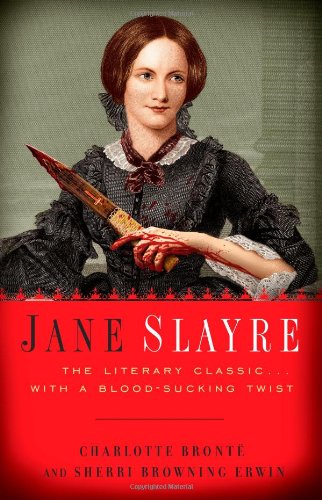
Jane Slayre - Charlotte Bronte and Sherri Browning Erwin


Well, this was the latest read selected for the 'Non-pretentious Bookclub'. And Non-pretentious is a good way to describe this new genre. Purists should steer clear but those after a chuckle and like a bit of slaying, staking and beheading, this type of thing is perfect.

This particular one, however, is probably not the best one to start with. While I found parts of it quite amusing, there were long stretches where not a lot happened.

Admittedly, I have not read Jane Ayre so, I can't really compare it to the original classic. However, I think that part of the fun for me was trying to work out what might have actually been happening in the normal version.

There were moments that I was laughing out loud at this book, but there were others in the bookclub that didn't find it amusing at all.

This genre might be viewed in light of "making the classics accessible", and while I would agree with that for the most part, personally I'm not against reading classics and have quite enjoyed the ones that I have. But then I can also see the humour in these. I am very much looking forward to when I have the time to read 'Pride and Prejudice and Zombies' and even more so, looking forward to the movie adaptation staring Natalie Portman: http://www.imdb.com/title/tt1374989/

Sorry that this review is a bit jumpy, it's been a few weeks since I finished the book. I'll try and review closer to finishing so I am more eloquent.